Cloud-Edge Integrated Digital Twin Platform for Scalable Smart City Applications
Keywords:
Digital Twin, Cloud-Edge Computing, Smart Cities, Internet of Things, Vehicular Edge Computing, Deep Reinforcement Learning, Federated Learning, Urban Cyber-Physical SystemsAbstract
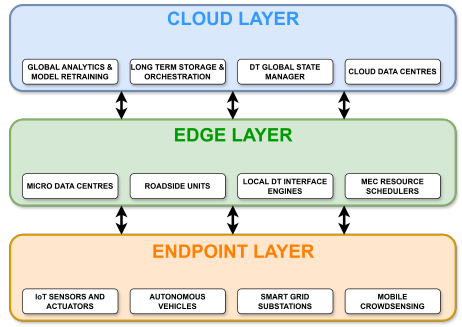
The proliferation of Internet of Things (IoT) technology and mobile crowdsensing technology in modern day smart cities has accelerated the development of smart cities, thereby resulting in the generation of unprecedented amounts of data that require real-time response and large-scale analytics. The concept of Digital Twin (DT) technology has become the foundational concept for the management of smart cities, thereby providing virtual representations of physical entities within the smart city environment using bidirectional real-time data flows. The use of centralized cloud computing technology for the management of smart cities results in unacceptable latency for performance-critical applications, whereas the use of edge computing technology alone lacks the computational power for the management of complex global scenarios. The present paper provides an exhaustive systematic review of the efficacy of Cloud-Edge Integrated Digital Twin technology for addressing the inherent latency problem associated with centralized cloud computing technology for the management of smart cities. The efficacy of the proposed three-tier taxonomy of deployment
strategies, including Edge-Heavy (Localized), Hybrid Cloud-Edge (Distributed), and AI-Orchestrated Dynamic frameworks, is assessed for the management of the following four critical smart city scenarios: Intelligent Transportation Systems, Smart Grids, Endpoint Security, and Massive IoT Crowdsensing. Key performance indicators like latency reduction, bandwidth utilization, and energy efficiency are discussed. From the review, it is clear that cloud-edge integration, if further enabled by deep reinforcement learning and generative AI, can ensure that DT platforms can attain inference latency below 50 milliseconds. This is while maintaining scalability across millions of connected endpoints. Additionally, the paper identifies the common challenges facing the DT domain, like interoperability, edge security, and dynamic twin migration. It further outlines the research roadmap towards the creation of fully autonomous and sustainable smart cities.