Machine Learning-Enabled Digital Twins for Smart Electronic Systems: A Review
Keywords:
Digital Twin (DT); Electronic Engineering; Cyber-Physical Systems (CPS); Internet of Things (IoT); Artificial Intelligence (AI); Machine Learning (ML); Power Electronics; Embedded Systems; Smart Grids; Predictive Maintenance; Real-Time Monitoring; Cloud and Edge Computing; System Modeling and Simulation; Fault Diagnosis; Lifecycle Management.Abstract
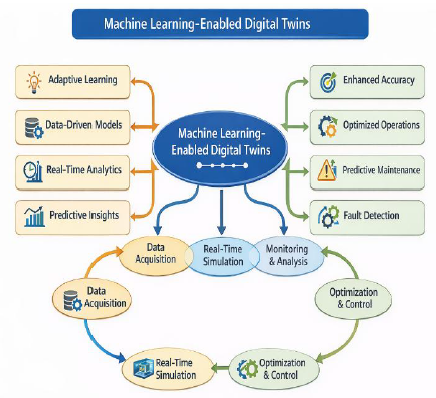
Digital Twin (DT) is a new change of paradigm in the electronic engineering and it offers a possibility to synchronize real-time between physical and virtual electronic systems. Digital Twins enable predictive maintenance, optimizing performance, diagnosing of faults, and managing lifecycle of electronic devices and systems through the integration of new modeling techniques, Internet of Things (IoT) connectivity, artificial intelligence (AI), cloud computing, and data analytics. This is a review paper where the author provides an in-depth discussion of Digital Twin architectures and modeling approaches, communication systems, and implementation schemes in electronic engineering such as power electronics, embedded systems, communication networks, semiconductor devices, and smart grids. Some of the enabling technologies investigated in the study include cyber-physical systems, edge computing, machine learning algorithms, and simulation platforms with high fidelity. Moreover, the data interoperability issues, computational complexity, cybersecurity, real-time synchronization and scalability are also discussed critically. An analytical overview of the current Digital Twin frameworks is also given to emphasize the performance metrics, system integration strategies and application specific adoptions. Lastly, the future research directions toward AI-controlled autonomous Digital Twin, energy-efficient hardware co-designed and next-generation intelligent electronic infrastructures are described. The objective of the review is to inform the researchers and practitioners with a systematized knowledge of the Digital Twin innovations and how they can transform the concept of intelligent electronic systems design, monitoring, and control.