Digital Twin-Driven Real-Time EMF Exposure Monitoring for Urban Distribution Substations
Keywords:
Digital Twin; Electromagnetic Fields; Distribution Substation; Real-Time Exposure Monitoring; ICNIRP ComplianceAbstract
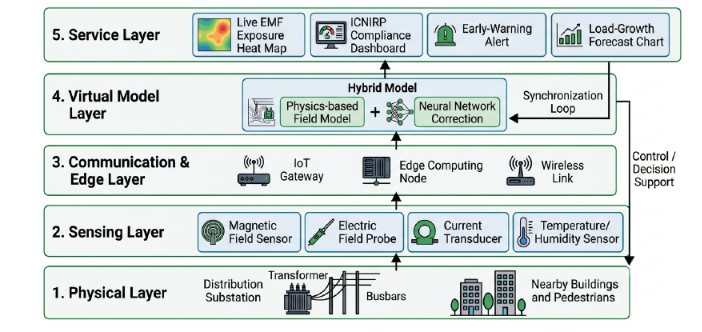
Distribution substations installed within dense commercial and residential precincts expose nearby people to extremely low frequency electromagnetic fields, yet compliance is usually verified through one-off field surveys that cannot capture time-varying load or network growth. This paper proposes a digital twin framework for continuous, spatially resolved estimation of electric and magnetic fields around urban distribution substations. The framework couples a physics-based field model with residual learning and Gaussian process interpolation, while a Kalman filter synchronisation engine with drift-triggered retraining keeps the virtual replica consistent with the physical substation. The twin generates live exposure maps at unmeasured locations, forecasts field levels under projected load growth, and issues uncertainty-aware early warnings against the reference levels of the International Commission on Non-Ionizing Radiation Protection. In a measurement-informed simulation study of a compact substation, the hybrid twin reduced the mean absolute error and root-mean-square error of magnetic flux density estimation by 56.4 percent and 65.9 percent relative to a physics-only model, and raised the coefficient of determination from 0.937 to 0.993. The maximum exposure ratio across the mapped area was 0.101, and the site remained compliant up to an 895 percent increase in operating current, equivalent to 47.1 years at 5 percent annual growth. Drift-triggered retraining reduced twin error by 46.7 percent compared with a non-adaptive twin after 72 hours. The approach turns static compliance surveys into continuous, predictive exposure management for utilities and urban planners.