Experimental Analysis of Photovoltaic Panel Characteristics and Application to Smart Residential Energy Management
Keywords:
Photovoltaic Panel, I–V Characteristics, Fill Factor, Single-Diode Model, Maximum Power Point Tracking, Battery Storage, Home Energy Management, Load Prioritization.Abstract
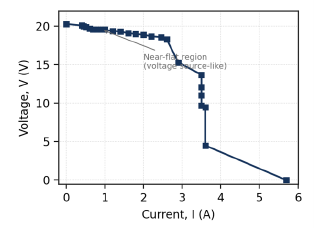
This paper reports an experimental characterization of a photovoltaic (PV) panel and proposes a framework that uses the measured characteristics for smart residential energy management. Voltage–current (V–I) data were recorded for a PV module under a controlled laboratory light source, and the power–voltage (P–V) relationship, fill factor, and operating points were derived from the raw measurements. The dataset yields an open-circuit voltage of 20.3 V, a short circuit current of 5.7 A, a maximum power of 47.95W at the maximum power point (13.7 V, 3.5 A), and a fill factor of 0.41. A single-diode model was fitted to the measured I–V data and reproduces the dominant operating region with a current root-mean-square error of approximately 0.23 A; a discrepancy between the measured short-circuit current and the current plateau is identified and discussed as a measurement artifact rather than concealed. Building on the validated characteristics, a rule-plus-optimization energy management architecture is proposed that couples maximum power point tracking (MPPT), battery storage, and priority-based load scheduling. The framework is described through energy-balance and state-of-charge formulations, and its expected benefits in self-consumption, peak shaving, and load continuity are evaluated qualitatively and through clearly labeled illustrative assumptions. Module conversion efficiency is reported conditionally because irradiance and module area were not recorded; this limitation, and the steps required to resolve it, are stated explicitly. The work links a standard teaching experiment to a deployable residential energy-management concept and identifies the additional instrumentation required for a fully quantitative evaluation.