Adaptive Digital Twin Framework for Real-Time Fault Detection in Distributed Computing Systems
Keywords:
Adaptive Digital Twin, Anomaly Detection, Distributed Computing Systems, Edge-Cloud Architecture, Machine Learning, Predictive Maintenance, Real-Time Fault Detection.Abstract
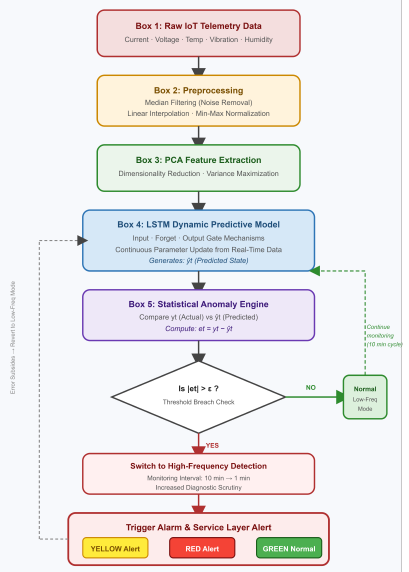
The rapid expansion and complexity of distributed computing systems have rendered traditional, static fault diagnosis methods inadequate, often resulting in high latency, reactive maintenance, and prolonged downtime. To address these systemic vulnerabilities, the Intelligent Adaptive Digital Twin (IADT) paradigm has emerged as a transformative solution, leveraging real-time bidirectional data synchronization and advanced machine learning to autonomously predict and detect operational anomalies. This paper presents a comprehensive review of state-of-the-art IADT frameworks tailored for real-time fault detection in distributed environments. We systematically examine the deployment of multilayered edge-cloud architectures, which optimize telemetry processing and significantly reduce latency. Furthermore, we analyze dynamic predictive modeling techniques including Long Short-Term Memory (LSTM) networks and Support Vector Machines (SVM) utilized for continuous state estimation and robust fault classification. A critical focus is placed on the evolution of adaptive monitoring policies that dynamically adjust diagnostic frequencies to conserve computational resources during normal operations. Finally, we synthesize empirical findings demonstrating the superior accuracy and resource efficiency of these data-driven frameworks and outline open research challenges, including federated data privacy, advanced AI integration, and the implementation of immersive visual analytics.