Federated Learning-Based Digital Twin Framework for Decentralized Smart City Systems
Keywords:
Digital Twin, Energy Efficiency, Internet of Things (IoT), Edge Computing, Predictive Modeling, Task Offloading, Smart City.Abstract
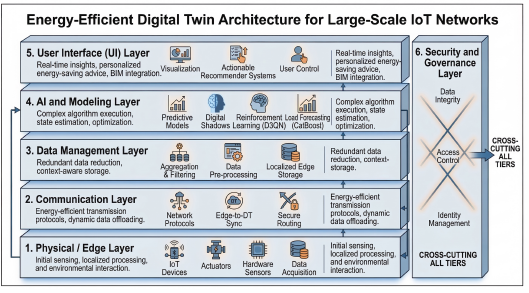
The rapid proliferation of Internet of Things (IoT) technologies has severely amplified the energy consumption bottlenecks of decentralized sensor networks. This paper presents a comprehensive review of energy-efficient Digital Twin (DT) architectures designed to mitigate the computational and transmission burdens placed on resource constrained edge devices. By shifting from monolithic cloud structures to multi-layered, edge-centric deployments, DTs provide a synchronized virtual environment to intelligently offload complex tasks. We evaluate state-of-the-art AI-driven mechanisms, including Reinforcement Learning (D3QN) for adaptive task offloading and ensemble regression models (CatBoost) for proactive energy load forecasting. Furthermore, this review analyzes practical implementations in smart environments, demonstrating how non-intrusive occupancy monitoring and dynamic Building Information Modeling (BIM) can yield significant quantitative energy reductions, such as a 79% decrease in intelligent lighting costs. Ultimately, this framework establishes a pathway for transforming reactive IoT networks into proactive, energy-optimized ecosystems.