Privacy-Preserving Digital Twin Models for Smart Healthcare Applications
Keywords:
Digital Twin, Healthcare, Privacy-Preserving, Federated Learning, Blockchain, Internet of Medical Things (IoMT), Edge Computing, Data Sovereignty, Cyber-Physical Systems, Unscented Kalman Filter.Abstract
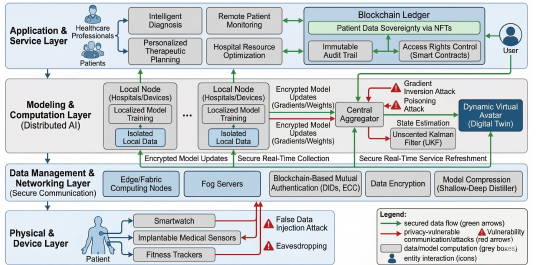
The integration of Digital Twin technology into Cyber-Physical Healthcare Systems signals a paradigm shift towards a new generation of personalized and predictive medicine. Through the continuous synchronization of physical biological states with dynamic virtual models using the Internet of Medical Things (IoMT) technology, it is now possible for medical professionals to transition from reactive medicine to proactive medicine. Nevertheless, the continuous transmission and aggregation of extremely sensitive physiological data pose a series of critical security challenges that include false data injection, massive data breaches, and the total compromise of data sovereignty for patients. In this paper, we present a comprehensive review of the latest privacy-preserving mechanisms for smart healthcare digital twins. We systematically examine the underlying multi-tier architecture of DTs and their underlying threat models. Moreover, we synthesize the latest results from three key technology pillars for digital twin technology that include Federated Learning (FL) for privacy-preserving machine learning, blockchain technology for establishing data ownership using Non-Fungible Tokens (NFTs), and edge computing for encrypted refreshment services. We then discuss key challenges for the technology that include consensus latency, algorithmic optimization on constrained devices, and regulatory compliance.