High Fidelity Digital Twin Modeling for Adaptive Aircraft Flight Control Systems
Keywords:
Digital Twin; Adaptive Flight Control; High-Fidelity Modeling; Aircraft Dynamics; Real-Time System Synchronization; Fault-Tolerant Control; Aerospace Cyber-Physical Systems; Intelligent Aircraft Systems.Abstract
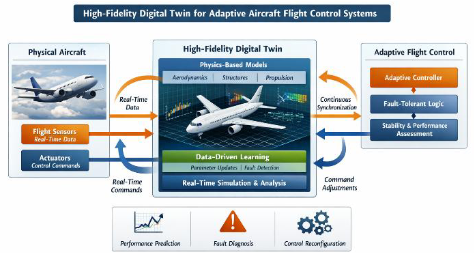
It is a new advanced systems of flight control which is required to adapt to dynamic conditions of operation and uncertain conditions of the system in the face of an increasing sophistication of modern aircraft and growing demands of safety, autonomy, and performance. The paper introduces a digital twin modeling high-fidelity framework of adaptive aircraft flight control systems that allows real-time synchronization of the real aircraft with the virtual one. The digital twin proposed will combine physical aerodynamic, structural, and propulsion models with data-driven learning processes to effectively model the nonlinear flight dynamics, environmental perturbations, and degradations of the components. A control architecture is created based on an adaptive control, in which the digital twin continuously integrates system parameters using real-time sensor data and enables proactive control of control laws to respond to changing flight conditions and fault cases. The framework helps to predict online performance, check the stability, and reconfigure the fault-tolerant control without disrupting the flight activities. Nominal, turbulent and fault scenarios at high-fidelity level exhibit considerable enhancement of tracking accuracy, intensity and versatility relative to the traditional fixed-parameter control strategies. The findings affirm that the presented adaptive flight control system based on a digital twin can improve the situational awareness, minimise anomaly response times, and increase flight safety and efficiency in general. The paper forms a scaled base of intelligent and autonomous aircraft systems of the next generation.